
Lab Muffin Beauty Science
AI-generated science content is super prone to factual errors. Here’s how to spot it…
Lots of typos and grammatical errors used to signal that something wasn’t checked carefully. Now, it’s AI slop signs.
It’s much easier to write in your own style than to get the facts right, so info with a lot of AI slop signs is likely to be unverified – you should probably verify it yourself.
Check out this article for a longer explanation for why AI chatbots can’t be trusted for science information.
Related post: Why you can’t trust AI chatbots for science
Formal tone, good grammar and punctuation, a few “tells” with other reasonable explanations and AI detectors aren’t very reliable for detecting AI use. All “AI signs” need to be considered in context – most are found in human-made content too!
The key is to spot so many signs that it’s very unlikely to be coincidence.
In general, I don’t think public callouts are all that productive:
It’s usually safer to just unfollow, and roast them in your group chats 😉
AI text has linguistic quirks that frequently show up, due to inherent biases in how they work. For example:
These tells change with the LLM model used, but historical signs are still useful. If older AI slop posts are still live, the person likely doesn’t know about the accuracy issues with AI chatbots, or don’t care, so they’re unlikely to have changed their processes.
Humans use these too in their writing, so again, seeing a few of these isn’t a good indicator of AI slop. But overuse – especially when it doesn’t make sense, or it’s out of character for the author – is a red flag.
Some people use screenshots of AI chatbots, or typical AI-generated infographic styles – Claude is very popular for generating science infographics at the moment. 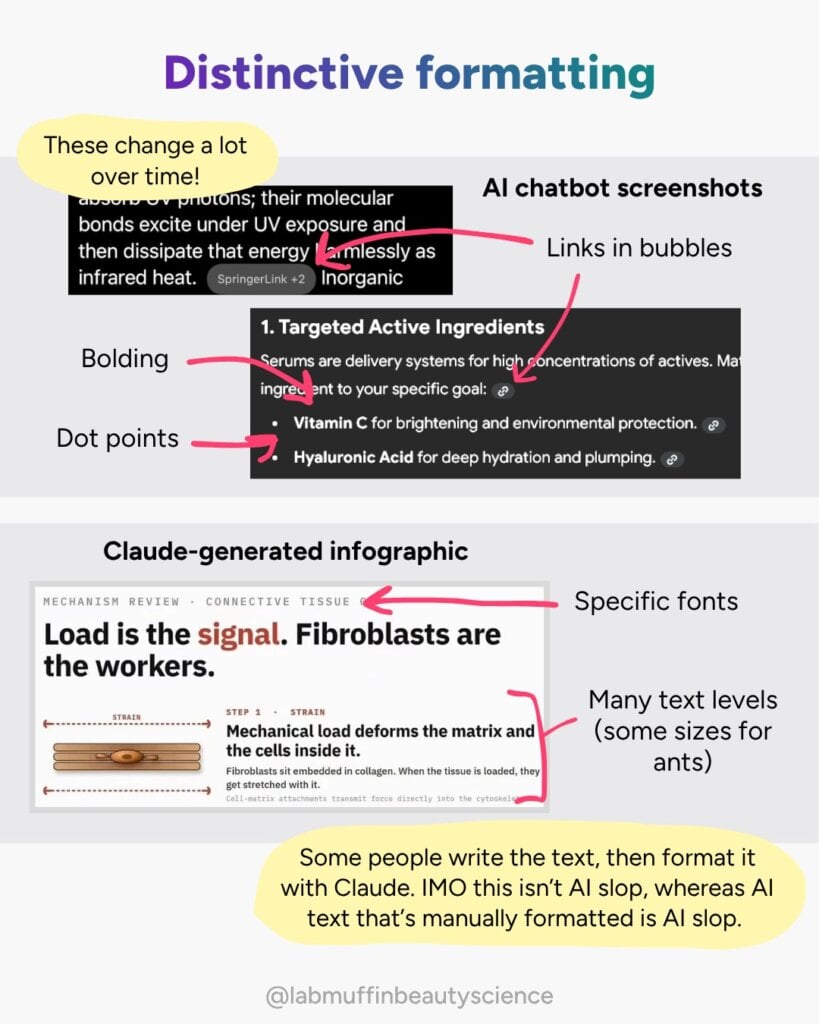
Note: Some people write the text, then format it with Claude. In my opinion this isn’t AI slop, whereas AI-generated text that’s manually formatted (also very common) would be AI slop.
Every human writer has a particular “voice”, or personality – so do AI chatbots. This is easier to spot if you’ve knowingly read a lot of AI text. The main signs in AI-generated science content:
Everything is super important and meaningful
Wordy, not information-dense
Note: These signs are for science content – AI voice is different for different contexts e.g. fiction. But one big sign is that many writers sound like they could be the same averaged-out generic person.
AI slop-posters are generally lazy (this is partly due to how AI chatbots are designed to foster dependence), so posters sometimes paste in text from the chatbot response, like quotation marks, or signposts like “Here’s a clean Instagram caption:” “Post 1”.
Some of these could come from an email, or could just be a typo – you’d want to see other slop signs to be sure.
It’s very quick and low-effort to generate AI slop, but accurate factual content takes a long time to make – it can take a few hours to read just one scientific paper properly! Scientific expertise is narrow, so it takes even longer if you’re new to a topic.
AI slop-posters tend to post longer posts, more often, on a wide range of topics, with great confidence.
(This is also a red flag for academic fraud – for example, the rosemary oil study author published 369+ papers in 2024.)
Look for inconsistencies between old and new content, or from post to post. Free ChatGPT launched late 2022, but AI slop really got going in 2025.
Examples:
This indicates that they may not know the downsides and limitations of AI chatbots, or might not care.
Note: someone saying that they “hate AI” isn’t good evidence that they don’t use it – lots of people have been caught using AI after denying it.
AI chatbots often make mistakes that humans are unlikely to make. These can be hard to spot if you don’t know the topic, but are often obvious if you check the original source.
AI chatbots are not good at organising ideas – they’re great at pattern-matching, but not judgement. Look for AI tells that don’t make sense, and don’t seem like human decisions.
This is a list of red flags for unreliable experts. The lack of concern about accuracy and ethics that underpins these also lead to AI slop-posting, in particular:
Humans posted misinformation carelessly before AI chatbots. Posting AI slop is another red flag for an unreliable “expert” whose information you should double check before trusting.
Here’s a passage with a lot of AI slop signs – how many can you spot? 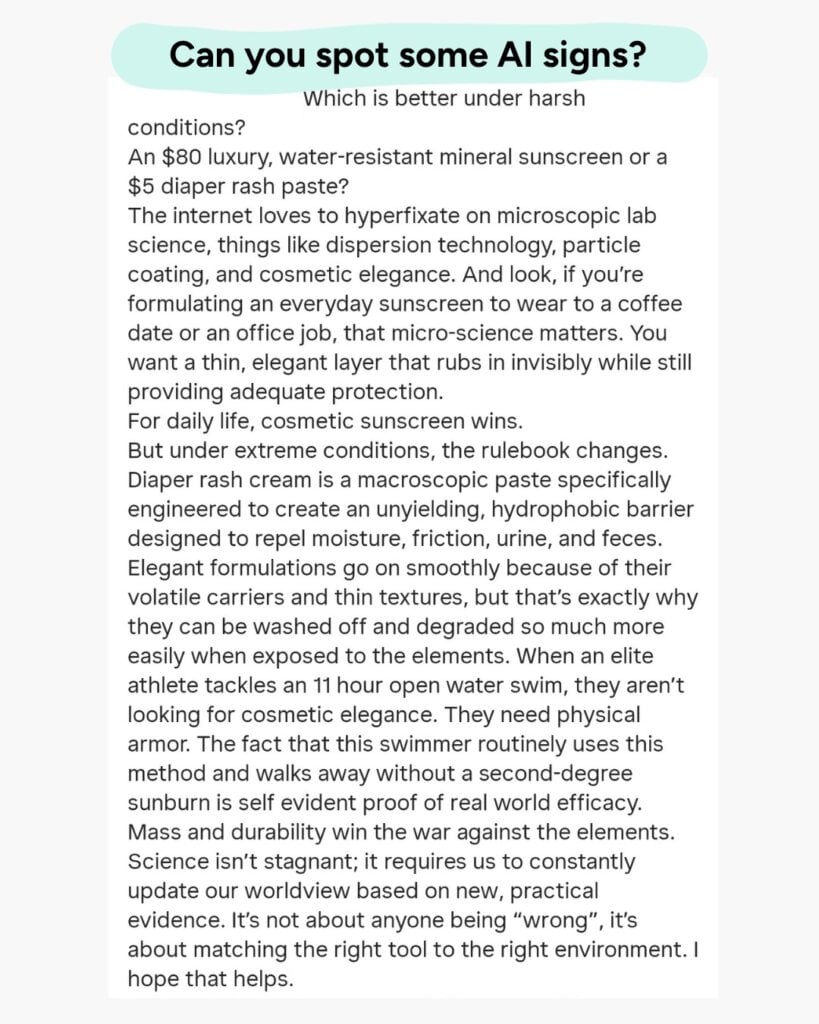
My analysis is here.
This article was adapted from my video on AI slop from science communicators. An infographic version can be found on Instagram or YouTube.
Fact-check: Don’t Get Burnt by DIY Sunscreen
Guest Post on The Toast!
How do deodorants work?
Do Coffee Scrubs Work Against Cellulite?

Hi! I’m Michelle, chemistry PhD and science communicator, and I’m here to help you figure out which beauty products are and aren’t worth buying, using science.
How to spot AI science slop – Lab Muffin Beauty Science
By: SUDO
September 26, 2026
Recent Posts
- Evolution and climate change are missing from Florida's proposed science standards – WFSU News
- Three UCSB researchers recognized for contributions to the earth sciences – UC Santa Barbara
- Sapphire discovery could reshape future brain-inspired electronics – anl.gov
- UAlbany Experts Explain the Science of a Perfect Pass – University at Albany
- STEM Education is on the Rise in America’s Afterschool Programs – Index-Journal
Recent Comments
No comments to show.
Subscribe to our newsletter!