
Update your browser to view this website correctly. Update my browser now
×
Home Case Studies
Loughborough University in the UK has upgraded its STEM teaching facilities with an open AVoIP infrastructure, designed to provide flexible content routing, centralised management and a scalable platform for future teaching requirements
By David Smith
An AVoIP platform from PlexusAV has been deployed across the Loughborough University’s STEM Labs, replacing a point-to-point AV infrastructure that had become restrictive as teaching requirements evolved. The system enables content to be routed between teaching spaces rather than being confined to individual rooms.
The deployment comprises 93 PlexusAV P-AVN-4 transceivers and the company’s Visual Array Management Platform (VAMP). The system supports H.264, H.265 and IPMX, while allowing existing network infrastructure and some previous AV equipment to remain in use.
The project was developed collaboratively by Loughborough University, AV integrator GVAV, onemedia and PlexusAV, with workshops and proof-of-concept testing used to assess the requirements. HDBaseT and Dante were considered before the team selected the AVoIP approach.
The system also addresses bandwidth limitations within parts of the existing network. Its ability to deliver high- and low-compression streams over a 1Gb network allows high-compression streams to connect multiple teaching spaces, while low-compression JPEG XS streams provide low latency within individual rooms. Centralised monitoring gives the university’s AV team visibility across the system, with Turlington-Smith reporting reduced reactive maintenance requirements.
Aaron Turlington-Smith, AV manager at Loughborough University, said: “Technology is the key enabler for us. It’s all about supporting the academics’ need for flexibility – presenting in different ways in a seamless, engaging and inclusive environment.”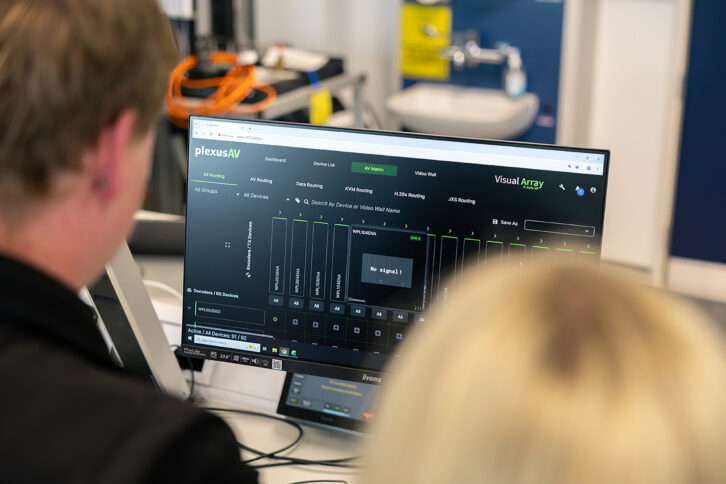 Scott Meikle, technical project manager at GVAV, said the infrastructure was designed around open standards to provide greater visibility and flexibility while allowing it to evolve.
Sustainability was also considered through PlexusAV’s Eco Mode, which reduces transceiver power consumption outside teaching hours. Across the 93-device deployment, the university estimates this will reduce energy consumption and operating costs by 40 per cent, with projected five-year savings of 42,664kWh of electricity, £10,960 in energy costs and 8.83 tonnes of CO₂e emissions. Turlington-Smith said the biggest improvement was flexibility, with staff now able to route content around the building without being constrained by individual teaching spaces.
You can subscribe to Installation magazine for free here and the daily newsletter here.
David Smith
David has been writing about various forms of technology, including AV, for more than 20 years. After training in local media, he worked for many years in London, then moved to York in 2008, where he works remotely and enjoys life in the historic City. As well as technology, he’s spent a lot of time writing for magazines and websites about cricket.
av over ip ⋅ GVAV ⋅ higher education ⋅ Loughborough University ⋅ onemedia ⋅ plexusAV
© 2026 Future Publishing Limited Quay House, The Ambury, Bath BA1 1UA. All rights reserved. England and Wales company registration number 2008885.