
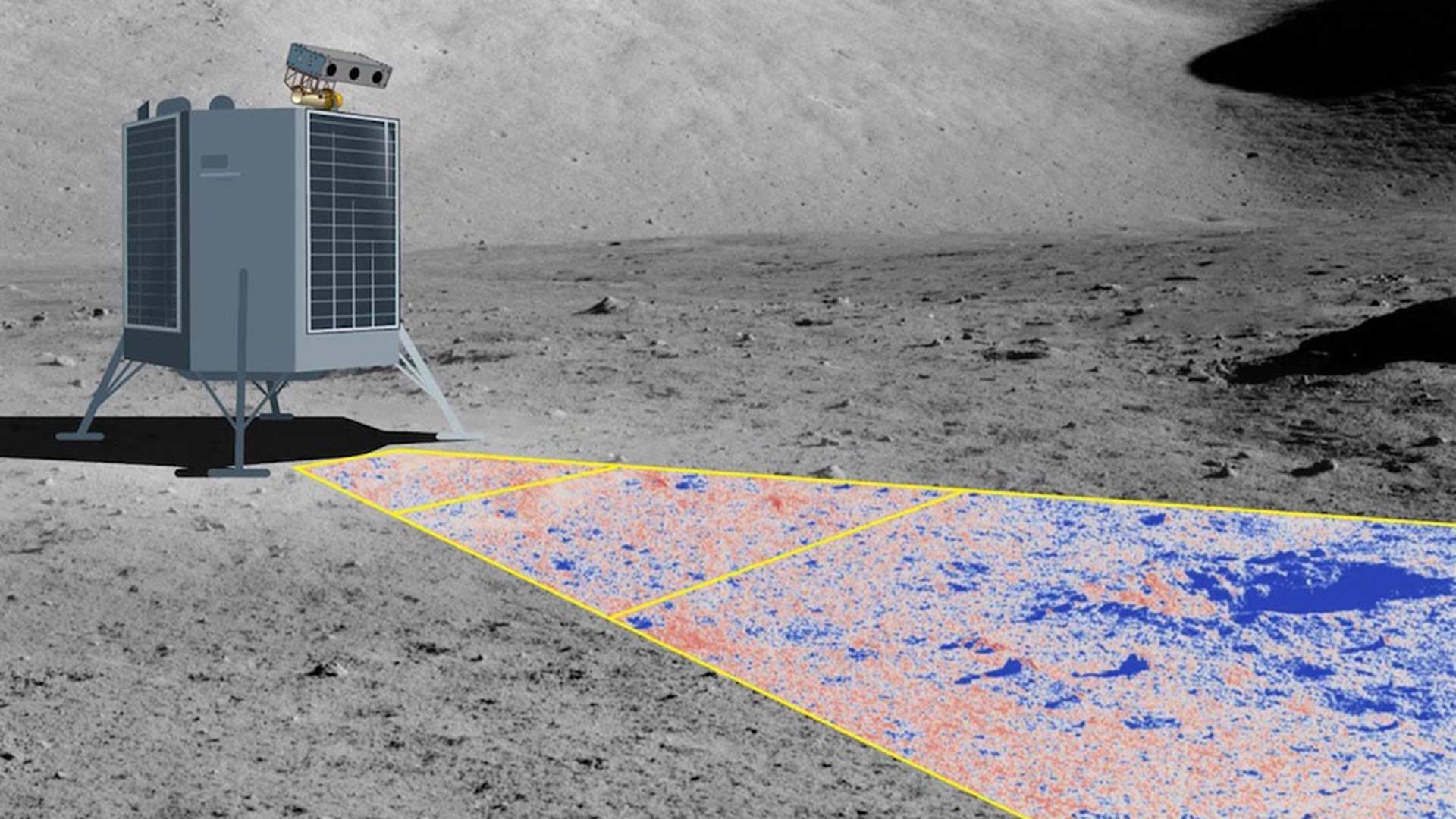
 VIEW LARGER Artist’s rendering of EMILIA 3-D scanning the moon’s surface from a commercial lunar lander.
A new moon landing mission could put a package of University of Arizona science experiments on the lunar surface by 2029. The mission will use a private company’s spacecraft as a low-cost alternative to a NASA flight to the moon.
UA lunar scientist Sarah Sutton is preliminary investigator for the EMILIA 3-D project. It is designed to look at how the moon’s soil impacts temperature change on the surface.
“Features that are a few centimeters up to a meter in size really affect the temperature and how we understand the properties of the regolith of the moon, which is the soil of the surface of the moon,” Sutton said.
EMILIA 3-D stands for EMission Imager for Lunar Infrared Analysis in 3 Dimensions. Its observations of temperature extremes could prove crucial for any long-term human settlement on the moon.
Sutton explains the university’s history with unmanned space exploration gives it an advantage over other schools hoping to give their own payloads a ride to the lunar surface.
“We have a lot of experience working with NASA missions and I think that puts us in a really good position.”
EMILIA 3-D is part of a series of projects NASA is contracting out to private companies sending small robotic landers and rovers to the moon. Intuitive Machines and Firefly have already successfully landed commercial spacecraft on the surface. Astrobiotic plans to put the first commercial lunar rover on the moon in November.